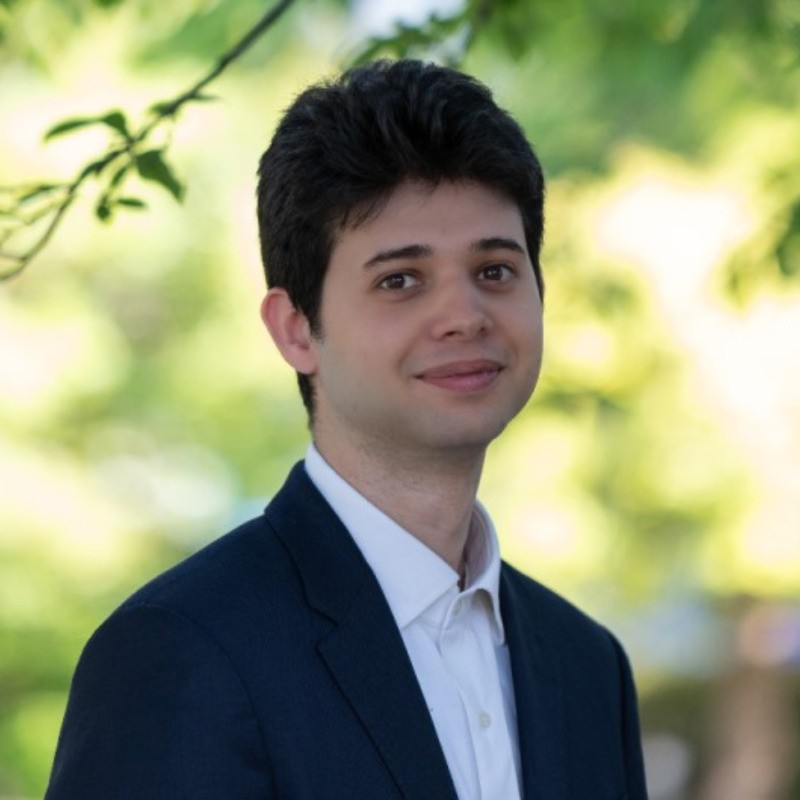
I am Othman Belgnaoui, an engineering student in Robotics and Interactive Systems, focused on autonomous systems, perception, simulation, and sensor-based robotics. My work is centered on projects where software interacts with physical systems: vehicles, underwater robots, sensors, operators, and real-world constraints. Through internships and technical projects, I have worked on multi-sensor calibration for autonomous vehicles, haptic shared control for an underwater ROV, OpenCV-based detection algorithms, ROS 2 development, simulation, and robotic supervision interfaces.
Outside of technical work, I practice climbing and horseback riding, and I have also been involved in student robotics leadership and volunteering.
View English Resume View French ResumeThe VACOP project (Open-Source, Plug & Play Connected Autonomous Vehicle) aims to develop a connected autonomous navigation platform on the autOCampus campus at IRIT. The goal is to enable the vehicle to navigate safely within a controlled environment, while providing real-time supervision and control through a dedicated web interface and a private 5G infrastructure.
My internship project, titled “Improving the Haptic Shared Control of a Remotely Operated Vehicle (ROV),” focused on simulating and enhancing underwater robotic teleoperation through shared control with force feedback. The goal was to reduce the cognitive load on human operators during inspection tasks involving 3D string-like objects (such as pipes, cables, or natural underwater features) by combining autonomous guidance with haptic feedback rendered in Unity. The core technical objective was to extend an existing planar (2D) control system to support full 3D motion while integrating a haptic loop that reflects environmental constraints and guidance forces. The system was implemented using the Unity engine.
Contributed to the development of autonomous-driving software for a Formula Student race car. The project focused on perception and simulation, including camera calibration, cone detection, track mapping, and testing in ROS/Gazebo/RViz. The goal was to help the vehicle understand cone-defined circuits and prepare it for driverless competition scenarios.
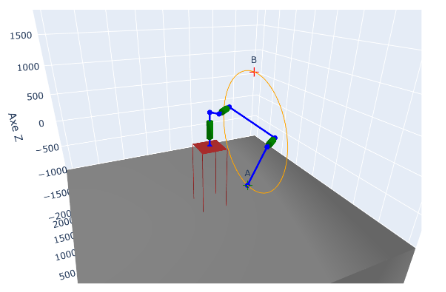
The RRR robot circular trajectory generation simulation aims to develop a modeling of an industrial robot arm with three revolute joints (RRR) and simulate its movement along a circular trajectory. The project involves creating a mathematical model of the robot's kinematics, implementing the trajectory generation algorithm, and visualizing the robot's motion in a simulation environment. The goal is to demonstrate the robot's ability to follow a precise circular path with predefine velocity and acceleration profiles, showcasing its potential applications in manufacturing and automation tasks.
Collaborative full-stack prototype for wheelchair rugby coaching, developed during an international design-thinking school with Stade Toulousain Handisport. I contributed to the connected-data architecture and Flask backend, receiving ESP32 sensor data such as shocks, heart rate, temperature and humidity, then exposing it through REST endpoints, WebSocket communication, SQLAlchemy models and a SQLite database. The system connects to an Angular dashboard used by coaches to monitor players, manage clubs, matches and championships, and visualize live sensor data. This project demonstrates my ability to integrate embedded sensors, backend APIs, real-time communication and user-facing tools into a functional engineering prototype.
Participated to an european design-thinking school focused on lunar prospecting organized by UNIVERSEH at AGH university in Krakow, Poland. In a team of 5 students from different countries and backgrounds, we designed a lunar prospecting campaign to extract water from the Moon's surface, using a combination of robotic rovers, drilling systems and solar-powered processing units.
Built a mobile robotics platform with manual control, voice commands, ball tracking, and real-time LIDAR mapping. I contributed to the system architecture, Angular interface, Flask/Socket.IO backend integration, Raspberry Pi communication, and testing of the robot’s interactive control modes.
Let's work together!
Send me an e-mail!